


Sheldonista Rebecca L. just reminded me of one of my favorite Sheldon toons: Christmas gift-giving, the Gift Card way!


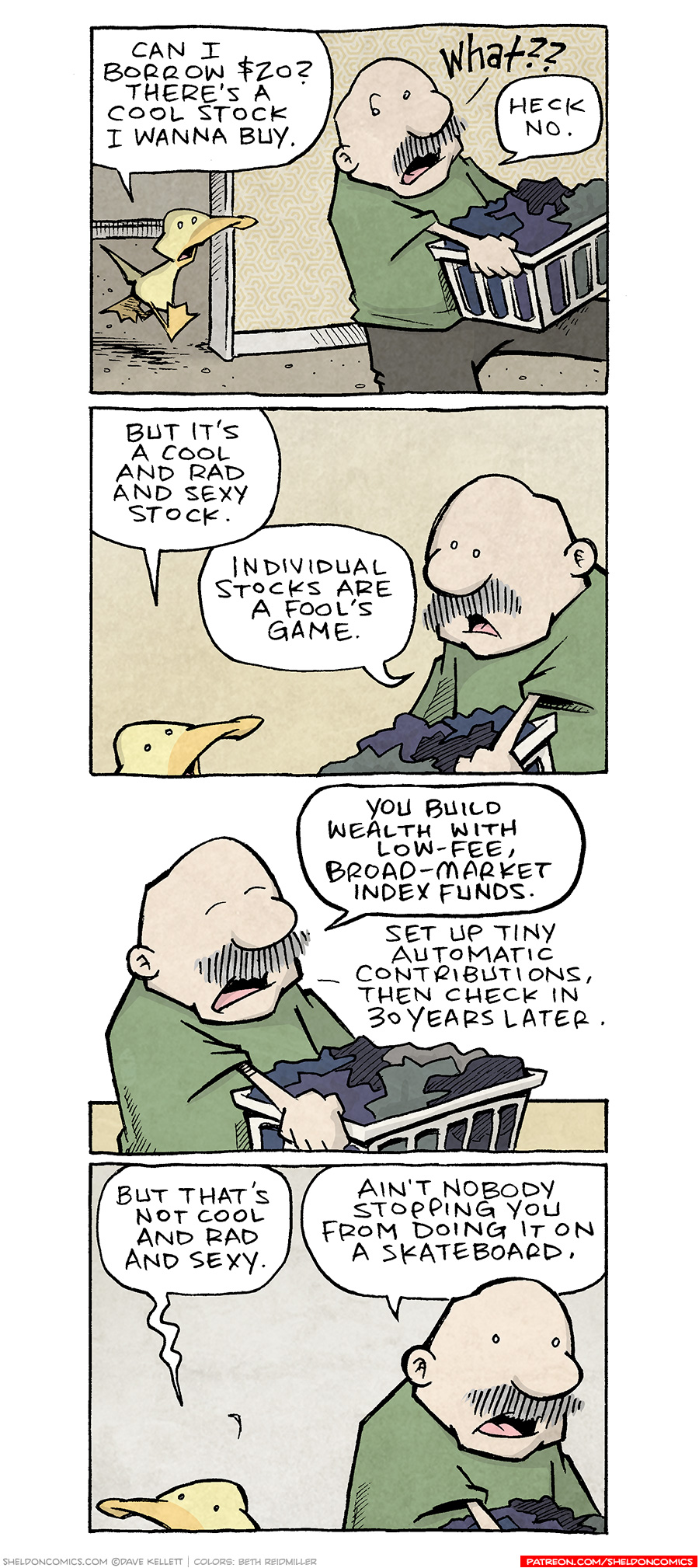






Sheldonista Rebecca L. just reminded me of one of my favorite Sheldon toons: Christmas gift-giving, the Gift Card way!
Very nice to be ranked #15 in Comixtalk’s 25 most influential
“People of Webcomics”
for 2007, along with my buddies Scott, Brad, and Kris of Halfpixel. To celebrate, I bought myself some Fig Newtons today.
Fig Newtons: The cookies that shouldn’t be awesome, and yet are.
Just wanted to publicly thank comic critic Gary Tyrell who, over at the Comixtalk 2007 Wrapup, put “Sheldon” in one of his five favorite reads for the year.
You know what I say to that? I say Gary is one of my top five things. That’s what I say to that.
Also: Anyone else notice that the Washington Post is linking to Sheldon, now, in their online comics section? Thanks, Washington Post! Any time you need help investigating President Nixon, give me a call! I’ll totally grab a coffee and hang out.
For Sheldon readers who also read the daily sci-fi comic strip Starslip Crisis, fun news! Jinxlets are coming! Pretty cool stuff if, like me, you love that strip.
Haven’t read Starslip before? Try it out! It’s one of my faves. So much so, that I’ll even use the word “fave” to describe it. Check it out!
Also, for everyone that asks: I’m still totally thinking of doing an Arthur and/or Flaco plush. It’s one of my hopes for 2008.
First! Because Sunday’s toon isn’t very Christmasy at all, here’s a past favorite toon for all the dog lovers out there.
Second! Last call for orders in the Store is Monday, Dec. 17th, for those using U.S. Priority Mail shipping and not paying by e-check.
Any orders after the 17th, and a Christmas delivery gets chancy. The Postal Service says that any Priority Mail packages posted by the 20th will get to all far-flung corners of the 50 states, but to be safe, we’re asking that your order be placed by the 17th.
We’ll still be sending out all orders after that, of course, but the 17th is still your best bet.
Sidenote: I think the above usage is the first time in my life I’ve ever written out the word “chancy”. What an odd word. It sounds like a 15-pound Chihuahua that loves watching “America’s Next Top Model”.
Having just watched “It’s a Wonderful Life” today, I wanted to share with you this past Sheldon favorite.
Ladies and Gentlemen, may I present…
Arthur’s diatribe about Uncle Billy.
1.) Just a heads up for U.S. gift-givers: Last call for Christmas purchases in the Sheldon Store is Dec. 17th, for those using Priority Mail shipping and not paying by e-check. There are always a few people (myself included!) that realize on the 23rd that they forgot to get a gift for Uncle Jim, so I try to give one last holler.
2.) Satisfaction guaranteed: It’s worth reminding folks that if your order arrives and there is anything out of place, drop me a line and we’ll fix it for you. Lots of times, it’s because the mailman crammed a 14″ package into a 4″ mailslot. That’s not your fault! And we’ll happily send you another one on us — or whatever it takes to get it right. We’re cool like that!
3.) For those that tried to get a “Lizard” Artist’s Edition today but missed it, my genuine apologies. Those final ten went in just a few minutes. (And if your heart was set on an Artist’s Edition, there are 19 left of “Pure Ducky Goodness” in the store.)
4.) And just a reminder for the gift-givers: Every Original Art purchase between now and Christmas comes with a free Sheldon book of your choosing! Just e-mail me after you’ve ordered, telling me which book you’d like! And it’s Swooshy McGee, in the mail to your door.
“Swooshy McGee?”
My dear, much-loved, highly intelligent brother-in-law John hails from Georgia, and one of my favorite Georgia-isms that he (rarely) uses is “I got this at the gettin’ store” or “You can get one of those at the gettin’ place.” It’s such a great phrase, and it always makes me laugh. I love it. So I had to work it in to today’s strip.
And, just to balance out the perception that I’m picking on Georgia unfairly, let me point you to three Sheldon strips that help show what a patently ridiculous place California is:
I actually think Georgia would be a great place to live for a while. My wife and I have a short list of 4-5 cities we’d like to live in before we die, and Savannah’s one of ’em. It has gorgeous, gorgeous architecture, a hip art scene…and I’d love nothing better than to teach sequential art (comics) at Savannah College of Art and Design’s excellent program. Georgia: It’s the new hotness.
SHORT VERSION:
10 unsold Artist’s Editions of “A Blizzard of Lizard” will be going on sale Thursday at 12 PM (noon) PST in the store.
LONGER, SLIGHTLY EMBARRASSING VERSION:
For reasons you can well imagine, I pay very close attention to the store’s automatic inventory count of Artist’s Editions. I never want them to oversell, since they exist in a limited number. But this time around, I paid *too* close attention, fiddled with the software system, and, as I’m now just realizing, ended up with 10 unsold copies.
Here’s what happened: 10 Sheldonistas paid for their Artist’s Editions using an “e-check”, which take about a week to clear. I was under the impression that the store software wouldn’t count those 10 purchases as a “completed sale” until the e-check cleared, and so manually adjusted the inventory count down by 10. Only now do I realize that was unnecessary, and that the software had taken them into accounnt.
So, I have 10 Artist’s Editions left, including the highly-coveted #250 (with the extra-cool, detailed sketch).
To be fair to the 45 or so folks who had e-mailed me asking if there were any left, I’ve decided to give a public notice, then put them on sale at a pre-announced time. So on Thursday at 12 PM PST, I’ll be putting these last ten up for sale in the store.
My apologies for any inconvenience!